author-placeholder

Dr Karl Baumgart

Consultant Physician, Clinical Immunology and Allergy; Director of Immunology, Douglas Hanly Moir Pathology, Sydney

More from this expert

Clinical Articles iconClinical Articles

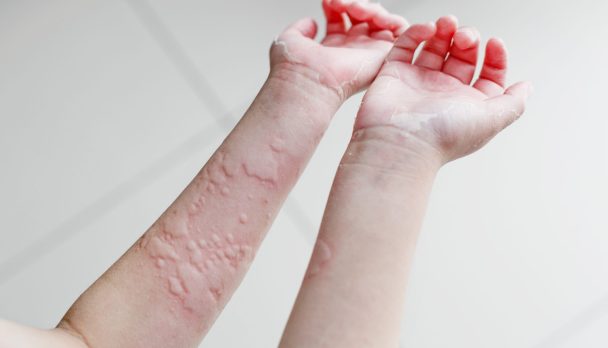
Urticarial lesions are usually intensely pruritic welts that can be generalised or localised. They normally last less than 24 hours in the one place, being migratory, and leave no residual marks on the skin. Angioedema lesions may be uncomfortable or sometimes painful and occur in the deeper dermis or mucosa and may take 72 hours to resolve.Acute urticaria may be allergic, mediated by inappropriate IgE responses to food allergens. It usually occurs rapidly after exposure to the causative allergen: within 30-60 minutes, up to six hours and rarely eight hours.The most common allergens are either ingested (food or oral drugs) or parenteral (bee or wasp stings or drugs, for example, penicillin). Aeroallergens are not usually the cause of allergic urticaria except when due to grains (in bakers) and latex. However, people who are allergic to grass pollen may develop localised urticaria on contact, for example, when sitting on the grass.

Urticarial lesions are usually intensely pruritic welts that can be generalised or localised. They normally last less than 24 hours in the one place, being migratory, and leave no residual marks on the skin. Angioedema lesions may be uncomfortable or sometimes painful and occur in the deeper dermis or mucosa and may take 72 hours to resolve.Acute urticaria may be allergic, mediated by inappropriate IgE responses to food allergens. It usually occurs rapidly after exposure to the causative allergen: within 30-60 minutes, up to six hours and rarely eight hours.The most common allergens are either ingested (food or oral drugs) or parenteral (bee or wasp stings or drugs, for example, penicillin). Aeroallergens are not usually the cause of allergic urticaria except when due to grains (in bakers) and latex. However, people who are allergic to grass pollen may develop localised urticaria on contact, for example, when sitting on the grass.

Clinical Articles iconClinical Articles

Last chance - $155 special ends midnight Sunday!

This is your last chance to secure discounted registration to both national seminars before prices increase on Monday! You're invited to attend Australia's most popular seminars for GPs and healthcare professionals.

Upcoming Healthed Webcast

POTS – What You Need to Know

Tuesday 17th February, 7pm - 9pm AEDT

Speaker

Prof Dennis Lau

Cardiac Electrophysiologist; The Royal Adelaide Hospital; Clinical Professor, The University of Adelaide

Hear the latest evidence-based management options for POTS - a common, yet poorly recognised and misunderstood autonomic dysfunction condition in our community. Join Prof Dennis Lau for an update on POTS, who is at risk, presenting symptoms and how it can be diagnosed in the primary care setting.